Table of Contents
What Is a Good Cost per Meeting for B2B SaaS?
How to Calculate Your Cost per B2B Sales Meeting
How to Book More B2B Sales Meetings Without Increasing Ad Spend
In-House SDRs vs Outsourced B2B Appointment Setting: Which Costs Less?
How Cleverly Books Qualified B2B Meetings Without Paid Ads or an In-House SDR Team
Conclusion: Book More B2B Meetings by Shifting Spend, Not Adding to It
Frequently Asked Questions
Modified On :
November 24, 2026
Key Takeaways
- A meeting only counts once it is held and qualified. Booked meetings flatter your numbers and hide your real cost.
- Cost per lead is not cost per meeting. The conversion rate between the two decides what you actually pay.
- Cheaper meetings come from fixing leaks first: weak targeting, thin follow-up, no-shows, and sloppy handoffs.
- Match the channel to your market size and deal value instead of defaulting to whatever your team already knows.
- In-house, agency, and pay-per-meeting models can all work. Each breaks in a different place, so pick based on your management capacity and speed needs.
Your ad budget went up last quarter. Your calendar didn't.
That gap is the most common complaint we hear from sales leaders chasing more B2B meetings. Throwing more spend at the wrong audience also backfires. Gartner found that 73% of B2B buyers actively avoid suppliers who send irrelevant outreach. Meanwhile, Belkins' 2026 study of 7.5M+ cold emails showed that follow-ups drive 58.6% of all replies. Stop after one touch and you leave most of your pipeline unclaimed.
One quick definition. A meeting can be booked, held, or qualified. Booked means it's on the calendar. Held means it actually happened. Qualified means the right person showed up with a real reason to talk. This guide measures held and qualified meetings, because that's what your AEs can close.
The short answer: shift budget toward outbound and work the leads you already have.
At Cleverly, we run LinkedIn lead gen, cold email outreach, and cold calling for B2B teams every day, so we've seen exactly where this math breaks.
What Is a Good Cost per Meeting for B2B SaaS?
A good cost per meeting for B2B SaaS is roughly $150 to $400 for low-ticket deals, $400 to $800 for mid-market, and $800 to $1,500+ for enterprise. There is no single number. The right figure depends on what a closed deal is worth to you.
You'll also see wildly different numbers online. Two reasons:
- Different definitions. One source counts a booked meeting. Another counts a held, qualified one. The second always costs more.
- Vendor bias. Most published benchmarks come from companies that sell outbound services or sales tools. That doesn't make them wrong. It means you should check what each one counts and who benefits.
We break this down further in our full guide on cost per sales meeting. Here, we'll focus on the math you need to cut your own number.
💸 More B2B Meetings Without More Ad Spend
Skip rising ad costs and reach decision-makers directly. Cleverly runs done-for-you LinkedIn, cold email, and cold calling campaigns to fill your sales calendar.
How to Calculate Your Cost per B2B Sales Meeting
Use this formula:
Cost per meeting = (team cost + tools + data) ÷ meetings held and qualified
Worked example: a 5-rep SDR team (illustrative)
Now the same spend, three ways:
- Cost per booked meeting: $40,000 ÷ 75 = about $533
- Cost per held meeting: $40,000 ÷ 52 = about $762
- Cost per held and qualified meeting: $40,000 ÷ 42 = about $952
Same team, same budget, and the "real" number is almost double the one on the dashboard.
Then chain it to revenue:
Cost per meeting ÷ meeting-to-opportunity rate ÷ close rate = cost per closed deal
At 40% meeting-to-opportunity and a 25% close rate, $952 becomes about $2,380 per opportunity and about $9,500 per closed deal. If your average deal is worth $8,000, you have a problem. If it's $60,000, you have a very good program.
Pro tip: Track all three versions of the number monthly. When booked cost looks fine but held cost balloons, your leak is no-shows. When held looks fine but qualified balloons, your leak is targeting.
How to Book More B2B Sales Meetings Without Increasing Ad Spend
You don't need a bigger budget. You need to fix four things, in this order. Each one lowers your cost per meeting in a different way.
Tighten Your ICP and Qualify Before You Book
Bad meetings are the most expensive meetings. Fix them at the source.
Narrow your ICP on three things:
- Title: the person who owns the problem or signs the check, not whoever replies fastest.
- Company size: where your product actually wins and retains.
- Trigger signals: a new funding round, a hiring spike, a leadership change, a tool switch.
Then write down what a qualified meeting means. Ours has three parts:
- Fit: they match your ICP.
- Authority: they can make or influence the decision
- Reason to talk: they've named a problem you solve.
If an SDR can't tick all three, it's not a meeting. It's a favor. Our full process lives in our ICP guide.
Add Outbound Channels That Book B2B Meetings Directly
Pick the channel based on your market size and deal value:
- LinkedIn suits a small total addressable market with high lifetime value. You can reach named decision-makers one by one.
- Cold email suits a large market where you need volume and tight targeting.
- Cold calling suits your highest-priority accounts, where a live conversation is worth the extra effort.
Calling costs more per meeting, but it also reaches people who ignore everything else.
The strongest programs don't pick one. They run channels together, which we cover in our comparison of LinkedIn vs cold email vs cold calling.
Work the Leads You Already Have
This is the cheapest lever on the list, because you already paid for the leads.
Two places money hides:
- Dead lists. Old CRM contacts, closed-lost deals, and stalled opportunities. Someone who said "not now" a year ago may be ready today.
- Speed-to-lead. An inbound lead contacted in minutes beats one contacted tomorrow. Every hour of delay costs you meetings you already earned.
Follow-up depth matters too. If your sequence ends after one or two touches, you're walking away from most of your responders.
Pro tip: Don't send the same email three times. Change the angle, the hook, or the proof point on each step. A new reason to reply beats a polite nudge.
Tools That Help: Best Email Sequence Software (12 Top Tools)
Raise Show Rates and Clean Up Handoffs
A booked meeting that doesn't happen is pure waste. It also quietly inflates your true cost per meeting, because you paid to book it and got nothing.
Our practical target is a 70%+ show rate. Three things move it:
- Confirmations: send one right after booking, with a clear agenda.
- Reminders: one the day before, one an hour before.
- Context-rich handoffs: the SDR passes the AE the prospect's pain, role, and what was promised, so the first call starts mid-conversation, not at zero.
When the handoff is thin, prospects feel like they're repeating themselves, and they cancel the next one. Treat the handoff as part of the meeting, not an afterthought.
📅 Turn Your Existing Leads Into New Meetings
Your next sales opportunity could already be in your database. Cleverly helps re-engage prospects and turn untapped leads into qualified B2B conversations.
In-House SDRs vs Outsourced B2B Appointment Setting: Which Costs Less?
You have three real options: build a team, hire an agency, or pay per meeting. None is universally cheaper. The honest answer is that in-house wins when you have the management capacity and time to ramp, and B2B appointment setting through an agency wins when you need pipeline quickly or want to test outbound without a long commitment.
The True Cost of an In-House SDR Team
Salary is the smallest part of the bill. When you price an SDR properly, you add benefits, payroll taxes, tools, data, management time, ramp time, and turnover. Together, those usually add 40% to 60% on top of base pay.
Published estimates for a fully loaded US SDR range widely, from roughly $75K to $100K a year at the low end to $118K to $170K at the high end. That's about $9,800 to $14,200 per month. The gap comes from location, seniority, and what each source counts.
Here's what usually gets missed:
- Ramp time. A new SDR often needs a few months before producing steady, qualified meetings. You pay full cost the whole time.
- Turnover. SDR roles churn. When one rep leaves, you restart hiring, training, and ramping, and your cost per meeting jumps for that stretch.
- Management time. Someone has to coach, review calls, and tune scripts. That's usually a sales leader whose hours cost more than the SDR's.
- Tools and data. Dialer, sequencing software, data enrichment, and email infrastructure all add up, and you pay for them whether the rep books meetings or not.
Pro tip: Divide your fully loaded monthly cost by held and qualified meetings, not booked ones. A rep who books 15 meetings and gets 8 held and qualified is a very different hire than the booked number suggests.
If you want a side-by-side view of how this stacks up against an agency, we break it down in our in-house SDR vs agency comparison.
Retainer vs Pay-per-Meeting Pricing
Pay-per-meeting sounds like the safest deal. It can be, but only if you read the fine print.
Typical ranges seen across the market run from about $150 to $600 per meeting. Specialty agencies targeting senior enterprise roles quote $300 to $1,500. Watch for three pitfalls:
- "Meeting" defined as booked, not held. You pay for no-shows.
- No no-show handling. Ask whether rescheduled or missed meetings are replaced.
- Weak qualification. If the provider is paid per meeting and nobody defines qualified, you'll get volume without fit.
Some providers prefer retainers because they allow continuous optimization of copy, data, and targeting. A retainer works well when you want steady testing. Pay-per-meeting works well when you want risk shared.
When to Outsource and When to Stay In-House
Outsource when:
- You need pipeline fast.
- You don't have the capacity to hire, train, and manage SDRs.
- You're testing outbound before committing to headcount.
Stay in-house when:
- The first call needs deep product expertise.
- Your sales cycle is so technical that an outside caller can't hold the conversation.
A 4-question checklist before you decide:
- Can you get a new SDR producing within 90 days?
- Does someone on your team have the time to manage them weekly?
- Is your first conversation simple enough to hand off?
- Do you know your cost per held, qualified meeting today?
If you answered no to the first two, outsourcing probably saves you money and time.
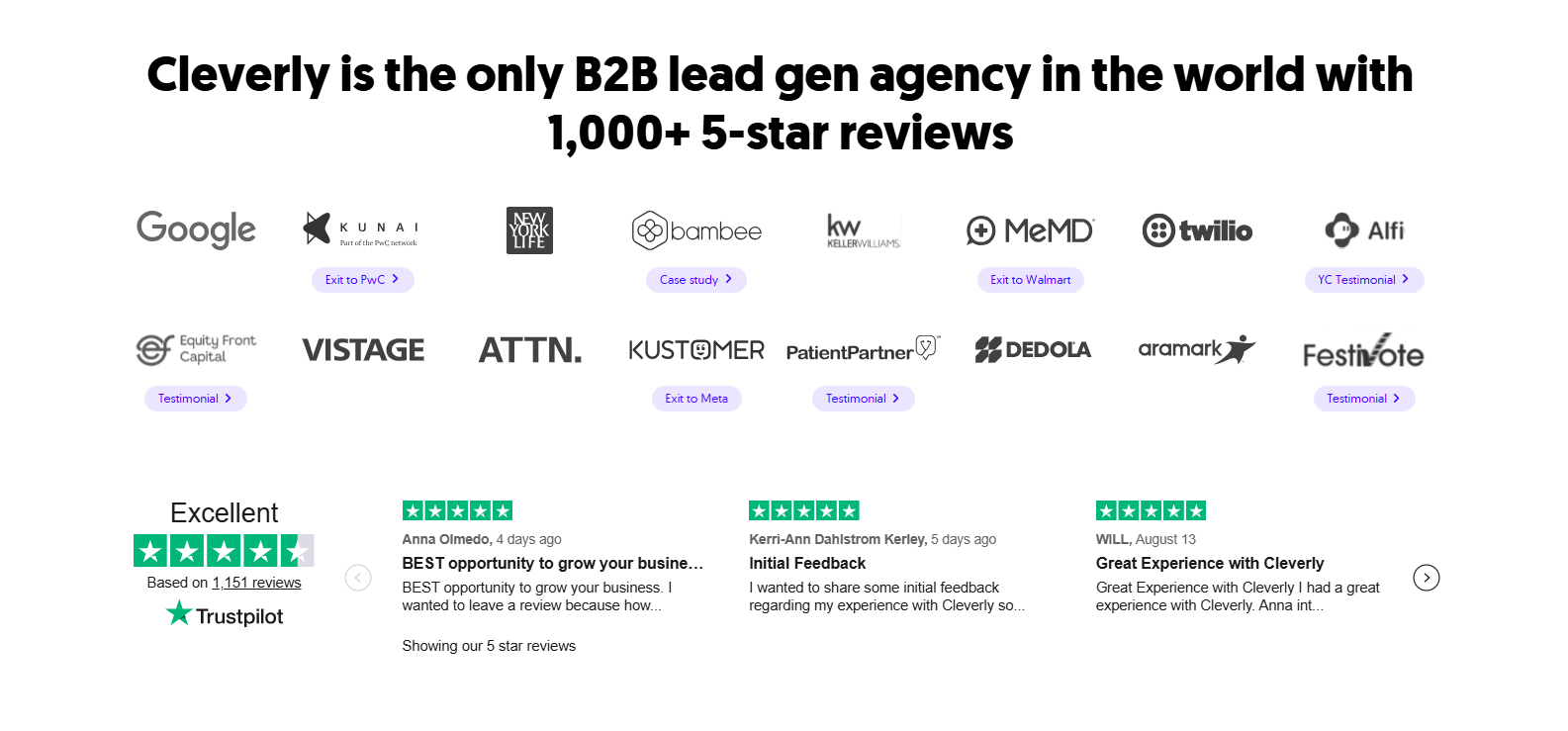
How Cleverly Books Qualified B2B Meetings Without Paid Ads or an In-House SDR Team
We built Cleverly for the problem this guide covers: you want more qualified meetings, and you don't want to hire, train, and manage an SDR team to get them.
We run LinkedIn outreach, cold email, and cold calling as a fully done-for-you B2B lead gen service, so research, copy, infrastructure, and follow-up all sit on our side. Everything is month-to-month, with no long-term contracts.
The mix depends on your market. LinkedIn lead generation at custom quote. Cold email comes in two models: Scale, where you pay per meeting-ready lead, and Growth, a flat monthly retainer. Our cold calling system puts a trained, no-accent appointment setter on your account within about two weeks, with scripts, data, and a power dialer included. It's built to book 10 to 30 qualified calls a month, and if it doesn't, we replace the SDR.
Doing this at scale is what keeps the process tight. Our clients have generated $312M in pipeline, and our callers have set 53K appointments. That volume means our messaging and qualification rules are tested before they reach your account.
If your cost per held, qualified meeting sits above the ranges in this guide, book a strategy call with us and we'll walk through your numbers together.
Conclusion: Book More B2B Meetings by Shifting Spend, Not Adding to It
The path to more B2B meetings starts with knowing your real number. Calculate cost per held, qualified meeting, then pull the cheapest levers first: sharper targeting, deeper follow-up, better show rates, and the leads already sitting in your CRM.
Quality beats volume every time. A smaller number of held, qualified meetings will do more for revenue than a packed calendar of no-shows. This week, audit your cost per meeting. If the numbers show a gap, that's your cue to talk to someone who runs this every day.
Frequently Asked Questions
Free Resource
How to Scale a Profitable Cold Call System
Get the complete guide — download it instantly now.

Free Ebook
Download the Free Guide
Enter your details to get instant access.
You're all set! 🎉
Your ebook is downloading now.
Click below if the download didn't start automatically.